
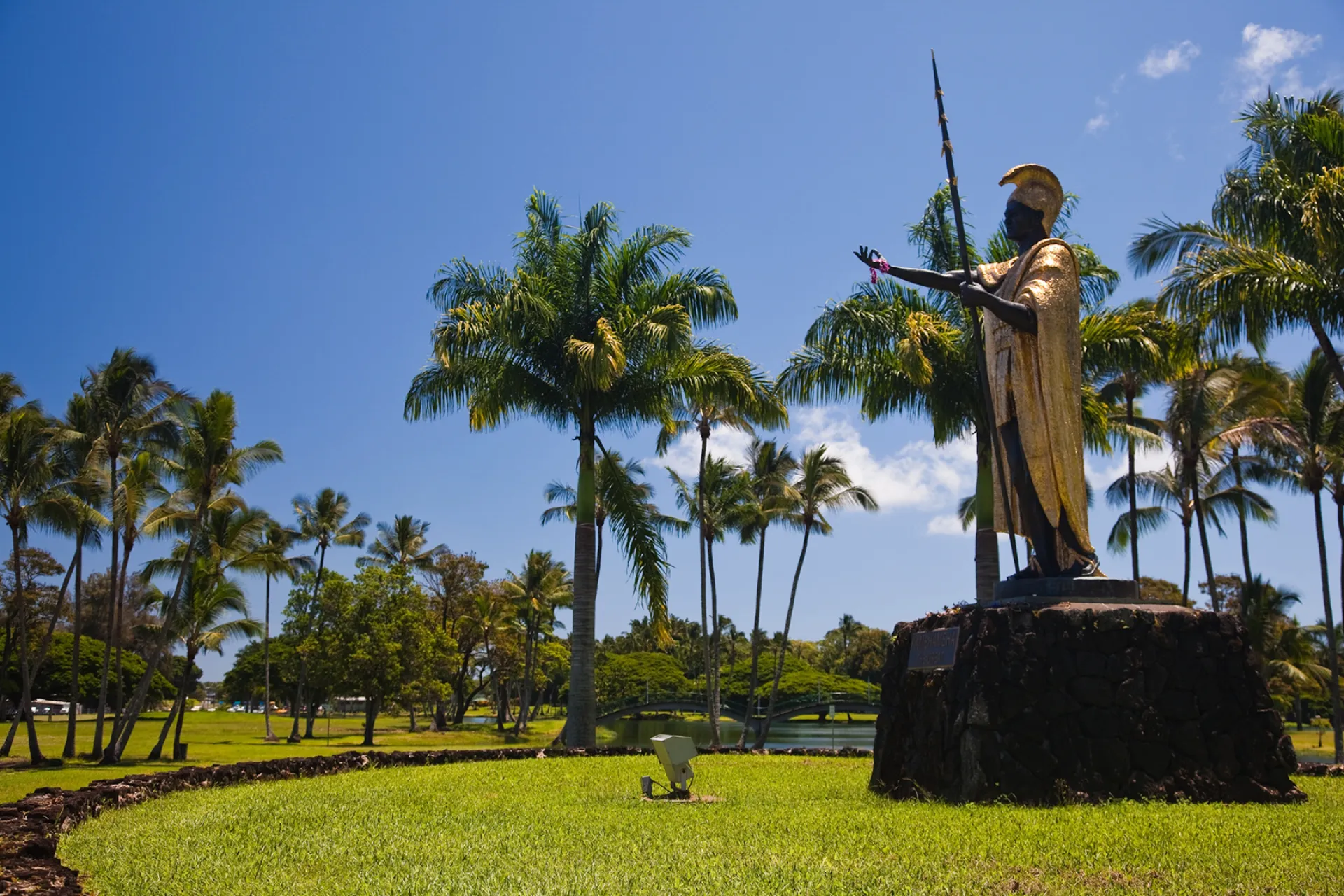
 King Kamehameha
The Story of King Kamehameha I
A great warrior, diplomat and leader, King Kamehameha I united the Hawaiian Islands into one royal kingdom in 1810 after years of conflict. Kamehameha I was destined for greatness from birth. Hawaiian legend prophesized that a light in the sky with feathers like a bird would signal the birth of a great chief. Historians believe Kamehameha was born in 1758, the year Halley’s comet passed over Hawaiʻi.
Given the birth name Paiʻea, the future king was hidden from warring clans in secluded Waipiʻo Valley after birth. After the death threat passed, Paiʻea came out of hiding and was renamed Kamehameha (The Lonely One). Kamehameha was trained as a warrior and his legendary strength was proven when he overturned the Naha Stone, which reportedly weighed between 2.5 and 3.5 tons. You can still see the Naha Stone today in Hilo.
During this time, warfare between chiefs throughout the islands was widespread. In 1778, Captain James Cook arrived in Hawaiʻi, dovetailing with Kamehameha’s ambitions. With the help of western weapons and advisors, Kamehameha won fierce battles at lao Valley in Maui and the Nuʻuanu Pali on Oʻahu. The fortress-like Puʻukoholā Heiau on the island of Hawaiʻi was built in 1790 prophesizing Kamehameha’s conquest of the islands. In 1810, when King Kaumualiʻi of Kauaʻi agreed to become a tributary kingdom under Kamehameha, that prophecy was finally fulfilled.
Kamehameha’s unification of Hawaiʻi was significant not only because it was an incredible feat, but also because under separate rule, the Islands may have been torn apart by competing western interests. Today, four commissioned statues stand to honor King Kamehameha’s memory. Every June 11th, on Kamehameha Day, each of these statues are ceremoniously draped with flower lei to celebrate Hawaiʻi’s greatest king.
The most recognized Kamehameha statue stands in front of Aliʻiōlani Hale (the judiciary building) across from lolani Palace and a short walk from the eclectic art galleries and restaurants of Chinatown. Dedicated in 1883, this was actually the second statue created after the ship delivering the original statue from Europe was lost at sea.
The original statue was miraculously recovered and in 1912, the restored statue was installed near Kamehameha’s birthplace at Kapaʻau on the island of Hawaiʻi. Visit North Kohala to see some of Hawaiʻi’s most sacred places like Puʻukoholā Heiau.
In 1969, the third Kamehameha statue was unveiled in the U.S. Capitol’s National Statuary Hall where statues of historic figures from all 50 states are on display. A statue of Molokaʻi’s Saint Damien joins the Kamehameha I statue in this amazing collection of art.
Hilo was Kamehameha’s first seat of government and this statue (pictured above), dedicated in 1997 at Wailoa State Park, is the tallest of the four statues at fourteen feet. Hilo is also home to the Naha Stone, which a young Kamehameha was said to have overturned in a feat of incredible strength. Legend said that whoever had the strength to move the Naha Stone would rule the Hawaiian Islands. Today, the Naha Stone is located in front of the Hilo Public Library.
Given the birth name Paiʻea, the future king was hidden from warring clans in secluded Waipiʻo Valley after birth. After the death threat passed, Paiʻea came out of hiding and was renamed Kamehameha (The Lonely One). Kamehameha was trained as a warrior and his legendary strength was proven when he overturned the Naha Stone, which reportedly weighed between 2.5 and 3.5 tons. You can still see the Naha Stone today in Hilo.
During this time, warfare between chiefs throughout the islands was widespread. In 1778, Captain James Cook arrived in Hawaiʻi, dovetailing with Kamehameha’s ambitions. With the help of western weapons and advisors, Kamehameha won fierce battles at lao Valley in Maui and the Nuʻuanu Pali on Oʻahu. The fortress-like Puʻukoholā Heiau on the island of Hawaiʻi was built in 1790 prophesizing Kamehameha’s conquest of the islands. In 1810, when King Kaumualiʻi of Kauaʻi agreed to become a tributary kingdom under Kamehameha, that prophecy was finally fulfilled.
Kamehameha’s unification of Hawaiʻi was significant not only because it was an incredible feat, but also because under separate rule, the Islands may have been torn apart by competing western interests. Today, four commissioned statues stand to honor King Kamehameha’s memory. Every June 11th, on Kamehameha Day, each of these statues are ceremoniously draped with flower lei to celebrate Hawaiʻi’s greatest king.
Downtown Honolulu, Oʻahu
The most recognized Kamehameha statue stands in front of Aliʻiōlani Hale (the judiciary building) across from lolani Palace and a short walk from the eclectic art galleries and restaurants of Chinatown. Dedicated in 1883, this was actually the second statue created after the ship delivering the original statue from Europe was lost at sea.
Kohala, Island of Hawaiʻi
The original statue was miraculously recovered and in 1912, the restored statue was installed near Kamehameha’s birthplace at Kapaʻau on the island of Hawaiʻi. Visit North Kohala to see some of Hawaiʻi’s most sacred places like Puʻukoholā Heiau.
National Statuary Hall, Washington D.C
In 1969, the third Kamehameha statue was unveiled in the U.S. Capitol’s National Statuary Hall where statues of historic figures from all 50 states are on display. A statue of Molokaʻi’s Saint Damien joins the Kamehameha I statue in this amazing collection of art.
Hilo, Island of Hawaiʻi
Hilo was Kamehameha’s first seat of government and this statue (pictured above), dedicated in 1997 at Wailoa State Park, is the tallest of the four statues at fourteen feet. Hilo is also home to the Naha Stone, which a young Kamehameha was said to have overturned in a feat of incredible strength. Legend said that whoever had the strength to move the Naha Stone would rule the Hawaiian Islands. Today, the Naha Stone is located in front of the Hilo Public Library.
